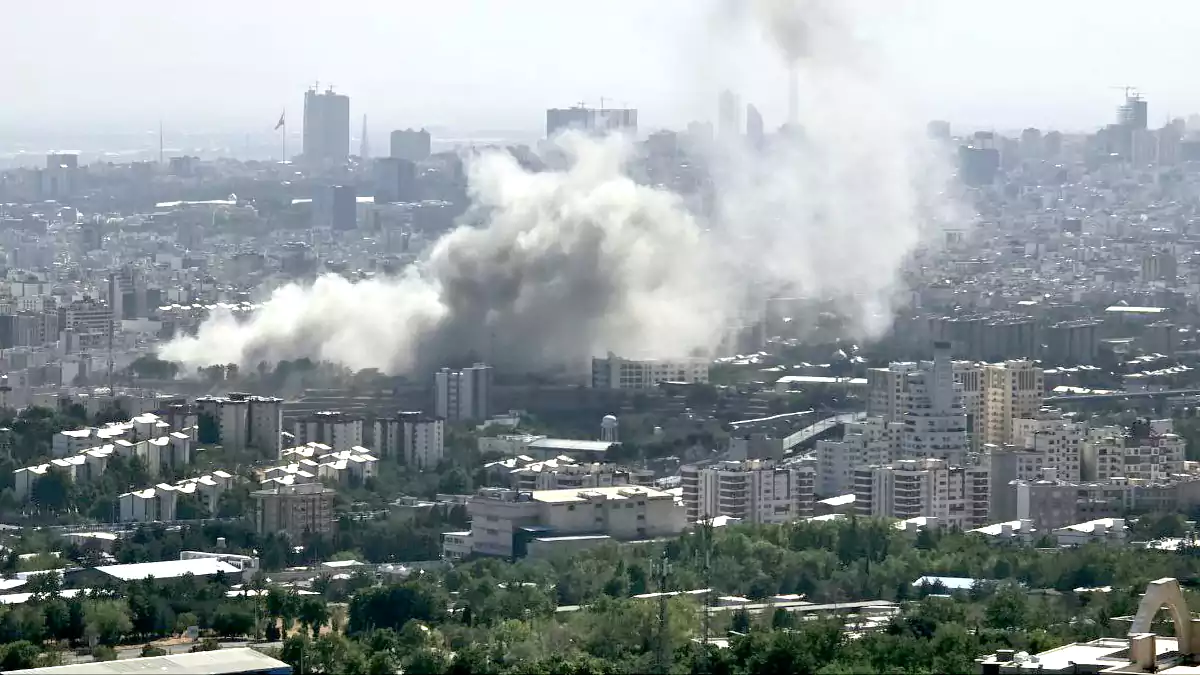
The Middle East where celebrations of Eid-ul-Fitr continue amid rising tensions and ongoing conflict. Let’s take a closer look at the situation.

Tensions between Iran and Israel remain high. Early Friday morning, Iran launched multiple ballistic missiles targeting Israel. Within just one hour, at least four waves of missile attacks were reported. Some of these included cluster missiles capable of causing widespread destruction.
Since Thursday, Iran has reportedly carried out at least 17 rounds of missile strikes against Israel. In response, air defense systems have been actively intercepting drones.
Despite the ongoing conflict, Eid-ul-Fitr has been celebrated across several Middle Eastern countries including Saudi Arabia, Bahrain, Kuwait, and Qatar.
Thousands of worshippers, including expatriates, gathered for Eid prayers after a month of fasting. The celebrations were filled with spiritual devotion, but the sound of missiles and drones continued in cities like Tehran and Tel Aviv, reminding الجميع of the fragile situation.
While most countries observed Eid on March 20, Iran and Iraq announced that Eid-ul-Fitr will be celebrated on March 21, following the completion of 30 days of Ramadan.
As the conflict intensifies, the United States is increasing its military presence in the region.
Approximately 4,000 Marines and naval forces are expected to be deployed, along with warships, F-35 fighter jets, and amphibious assault vehicles. Analysts believe this move could significantly impact regional security, global politics, and energy markets.
In a notable development, Israel’s Prime Minister Benjamin Netanyahu has reportedly agreed to temporarily pause future strikes on Iran’s gas fields following a request from Donald Trump.
However, despite this, attacks across Iran and neighboring regions continue, indicating that tensions remain far from resolved.
In recent hours, missile and drone attacks have been reported in the UAE, Kuwait, Saudi Arabia, and Bahrain. Both the UAE and Bahrain have blamed Iran for these attacks.
Meanwhile, the United States has approved a massive $23 billion arms deal to strengthen defense systems in the region, supplying advanced weapons to countries like the UAE, Kuwait, and Jordan.
Experts are warning of a sharp rise in cybercrime linked to the conflict.
Over 8,000 fake websites have been created using war-related keywords in just the past month. Fraudulent sites are targeting users to steal login credentials and financial data, posing a serious threat to individuals and organizations.
Iran’s Revolutionary Guard has claimed responsibility for a missile strike on Israel’s Haifa oil refinery.
Following the attack, a fire broke out at the facility and power supply was temporarily disrupted. Iran also claims it targeted additional energy infrastructure, including refineries in Haifa and Ashdod.
In a separate incident, a US F-35 fighter jet was damaged during operations and forced to make an emergency landing at a US base in the Middle East. The pilot is safe, and an investigation is currently underway.
Even during the sacred occasion of Eid, conflict continues to escalate across the Middle East.